
The buzzing of drones navigating obstacle courses, lines of code running across screens, and cheers after each experiment—these were the vibrant sounds echoing through Dewey Cau Giay’s “giant lab” during last weekend’s Secondary & High School Science Fair. Under the theme Science of Solving, TDSers took on the role of “school detectives,” applying mathematical and scientific thinking to tackle a series of real-world, globally relevant challenges.
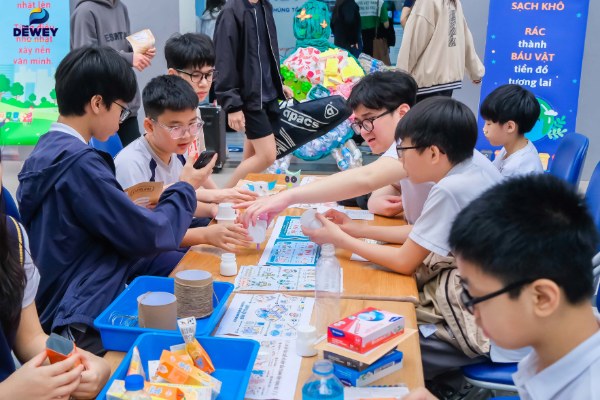
The first impressive stop was the science exhibition area—considered a “museum” of dedication that showcased students’ persistent research journeys. Each model and report was not only the result of hours of study and inquiry, but also clear evidence of design thinking and the practical application skills of Dewey students.
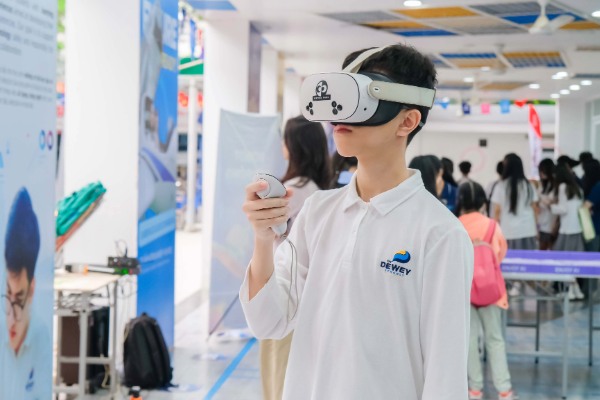
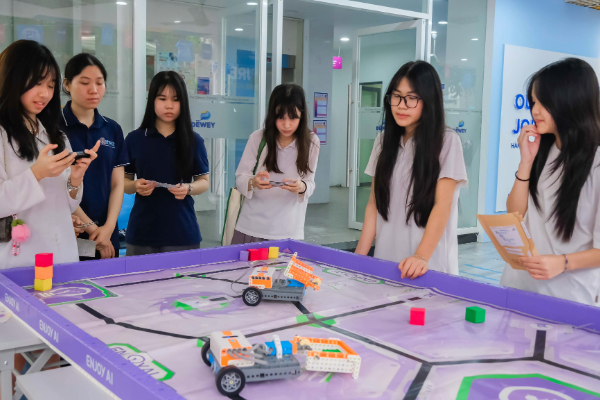
The excitement peaked at the technology experience stations. At the AI Superhero Lab, young “engineers” directly controlled artificial intelligence to bring their personal ideas to life. Nearby, skillful drone navigation lit up the SkyRace track, while immersive role-playing experiences unfolded in virtual reality (VR). Each challenge became an “open test,” measuring students’ ability to master technology, think logically, and adapt in an ever-changing world.
Science and mathematics came alive through hands-on experiments such as paper rockets, artificial salmon roe, elephant toothpaste, and number mazes. Through each activity, students realized that seemingly complex problems can be understood by grasping the right principles and connecting knowledge to real life.
Beyond exploration, the event also created space for students to express social responsibility. The “Recycling Innovation Workshop,” in collaboration with the Trash Lovers community, highlighted another dimension of science—not only creating solutions, but also striving for sustainability.
The journey concluded with the My Project Grand Finale, where ideas were elevated into well-structured arguments. On stage, students confidently presented their projects, defended their viewpoints, and engaged in critical debate. It was a moment when many parents recognized that what their children gained went far beyond formulas—it was about how they think and solve problems.
The Science Fair may have ended, but what remains is not just the models or challenges—it is a way of learning: learning through experience, through solving real problems, and through actively constructing knowledge. This is also the educational philosophy of The Dewey Schools: every learning activity goes beyond textbooks, aiming for deep understanding and real-world application—empowering students to step into the world and confidently solve the challenges of the future.