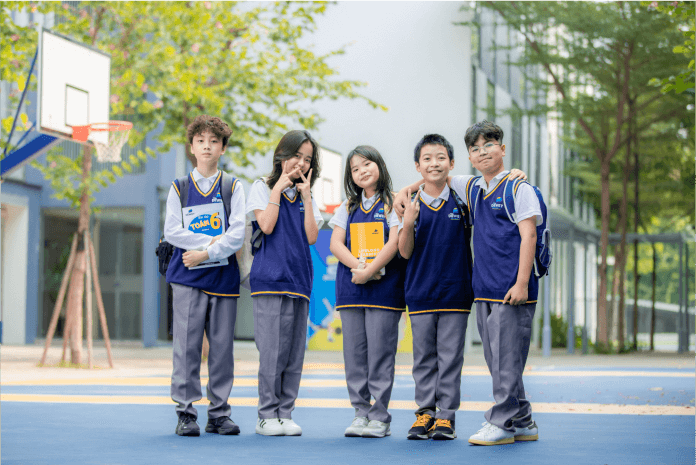

From the very first days of Grade 6, students in the Vietnamese Literature Program at The Dewey Schools are not greeted with abstract concepts or rigid theories. Instead, their learning journey begins with a simple, profoundly human question:
“Why do people create art?”
A Literature class at TDS always starts with questions like: “Why do people write poetry?”, “Why do we tell stories?”, “Why do people paint?”, “Why do people make music?”
These seemingly simple questions are, in essence, the doorway to a deeper journey of self-discovery. By exploring why humans create art, students learn to understand emotions, listen to their inner thoughts, and explore their unique voice. Each lesson becomes a space where students are invited to ask:
How do I feel about this? What do I think? How would I write, tell, or illustrate this if it were my story?
Thus, the study of Literature transforms from memorizing texts into a personal journey of inquiry, discovery, and growth. This is the story of how Vietnamese Literature becomes an engaging and meaningful learning experience at The Dewey Schools.
Overview of the Vietnamese Literature Program (Middle School)
At The Dewey Schools, the Middle School Vietnamese Literature Program is based on the Cánh Buồm textbook series, founded by educator Phạm Toàn. The authors, anchored in the mission of “fostering the intellectual development of the nation’s youth,” emphasize that the nine-year Basic Education program equips every child with three essential capacities: (1), A sound method of learning, (2) Coherent, rational thinking, and (3) Practical competencies and moral grounding for life at age 15-16.
These principles shape the entire curriculum from Grade 6 to Grade 9, nurturing students to become proactive, curious, and adaptable learners for the modern world.
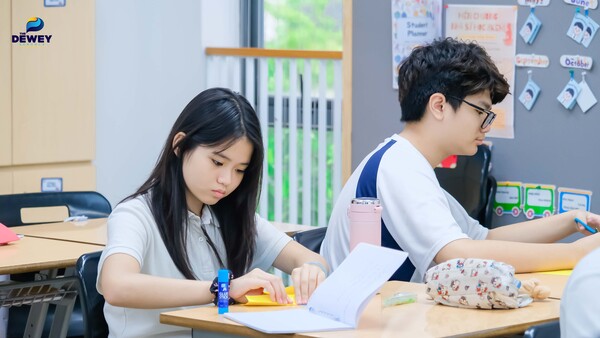
A unified, developmental curriculum
The nine-year Vietnamese program is designed as a coherent whole, consisting of two interconnected strands – Literature and Vietnamese Language.
- In Grade 6 Literature, students explore artistic inspiration as the origin of all creative works.
- In Grades 7 and 8, they decode texts: Grade 7 focuses on lyric and dramatic genres, while Grade 8 emphasizes narrative forms from folklore to contemporary fiction.
- In Grade 9, students advance to research-level inquiry, studying masterpieces of Vietnamese and world literature and strengthening their autonomy as learners.

In the Vietnamese Language Program:
- Grade 6 studies the history of Vietnamese writing systems, nurturing appreciation for the linguistic heritage of the nation.
- Grade 7 expands vocabulary knowledge and dictionary skills.
- Grade 8 introduces modes of expression across scientific, artistic, and socio-political contexts.
Grade 9 fosters abstract thinking through themes such as the environment, beauty, love, and mortality.
Vietnamese Literature in Middle School – A Journey of Potential
John Dewey, the influential American educational reformer, believed that every child possesses limitless potential. In Democracy and Education, Dewey emphasized that education must create the conditions for children’s full and free development in both body and mind. Anchored in this philosophy, The Dewey Schools design every program – including Vietnamese Literature – to place students at the center of learning, nurturing their intellectual and emotional potential to its fullest.
A Journey of Knowledge Construction
Learning is like a treasure map – each concept is a clue leading students toward unexplored parts of themselves.
The Literature strand empowers students not only to analyze texts but to feel them. They learn to empathize with the emotional world of writers, to perceive the subtleties behind words, and to connect their own experiences with the artistic expressions they encounter. Classes begin with emotional warm-up activities that activate curiosity and foster intrinsic motivation. The Cánh Buồm approach guides students from initial fascination to independent study, enabling them to cultivate genuine artistic appreciation not through memorization, but through inquiry and experience.
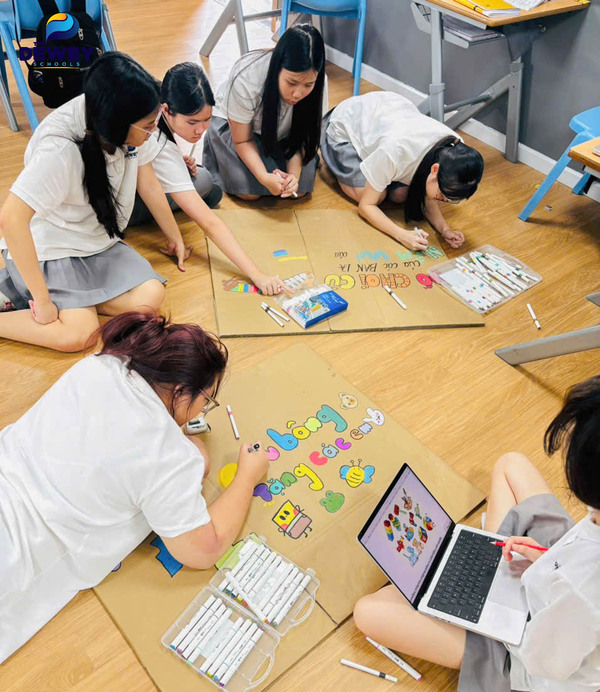
Curriculum selections reflect thoughtful pedagogical intent: texts are age-appropriate yet intellectually stimulating, balancing accessibility with depth and challenge. For example, in Grade 9, students explore The Tale of Kiều: they participate in traditional folk practices such as đố Kiều or bói Kiều, while also engaging with the profound humanistic values of this national masterpiece.
Across grades, students encounter a diverse literary landscape – lyric poetry, drama, narrative works, Vietnamese and international texts – broadening their cultural and intellectual horizons.
Potential Emerges Through Guided Exploration
As the Cánh Buồm pedagogical manifesto states: “The Cánh Buồm method is LEARNING BY DOING – creating conditions for learners to act, to discover, and to draw their own conclusions.” This aligns with John Dewey’s philosophy of experience-based learning. Instead of passively receiving information, students answer their own questions through structured learning tasks. Example: When exploring Southern Vietnamese phonetics, students are not given definitions. They listen to authentic recordings, complete tables titled “What do I hear?” and “What do I understand?”, and independently infer distinctions such as the /w/ sound in “wa” (Southern pronunciation of “qua”).
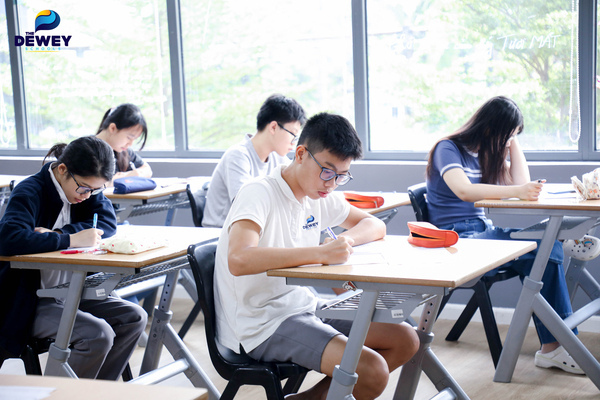
Inquiry-based learning—rooted in Socrates’ principle “Questioning is the beginning of wisdom” – enables students to construct knowledge, connect ideas, and develop autonomy in thinking. They become investigators, not recipients.
From Potential to Talent—Learning Through Projects
Project-based learning is also central to the program. Howard Gardner’s theory of multiple intelligences affirms that students express strengths in different ways—linguistic, spatial, musical, interpersonal, and more. Projects provide a platform for these diverse strengths to surface and flourish.

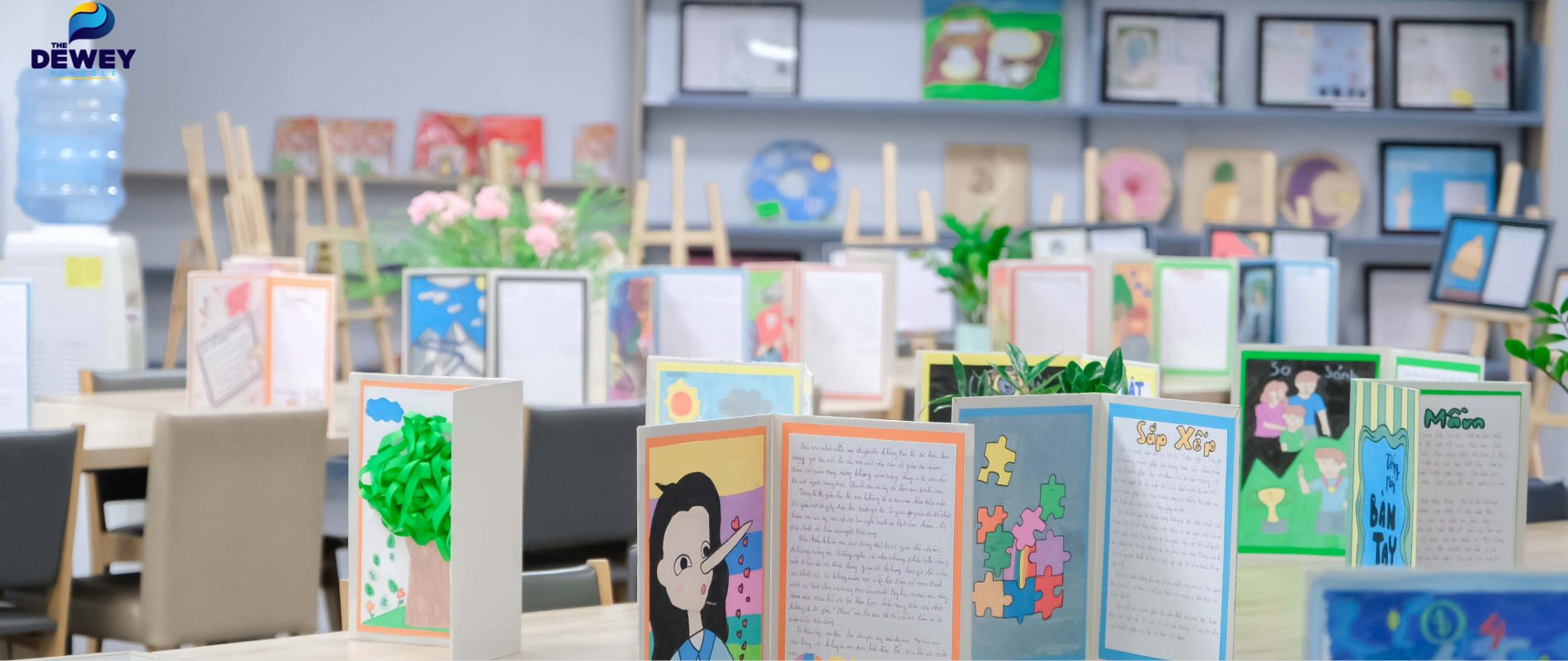
In Grade 9’s Tale of Kiều project, students created:
- Tarot card sets inspired by the characters
- Original songs expressing Kiều’s emotional journey
- Scripted plays offering new interpretations
Similarly, in Grade 7 Vietnamese Language, after studying dictionary genres, students compile their own Vietnamese explanatory and associative dictionaries – designing entries, covers, page numbers, and user guides.
Through such work, students discover talents they never knew they had.
When Potential is Unlocked
Vietnamese Literature is not an easy subject: it demands knowledge, empathy, critical thinking, and expressive skill. It requires both logic and emotion, both analysis and imagination. But at The Dewey Schools, students encounter Literature in a way that is accessible, engaging, and deeply meaningful. Their artistic sensitivity and linguistic competence develop naturally through inquiry, exploration, and self-directed learning.
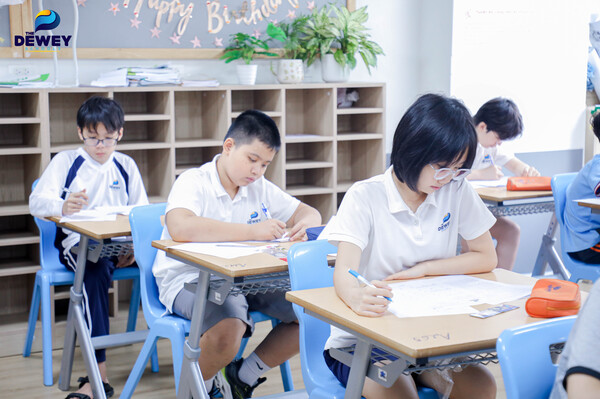
When potential is awakened, students do not simply write better or speak more confidently – they think independently, communicate effectively, and grow in their understanding of humanity and life.
This is the portrait of a Dewey learner: intellectually mature, self-directed, and capable of navigating their own learning journey.
Written by Ms. Nguyễn Vân Anh & Nguyễn Ngọc Hà Phương – Educational Research and Pedagogical Council (ERPC), The Dewey Schools.