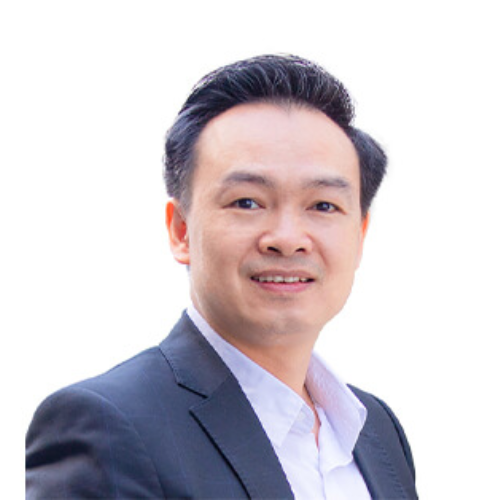

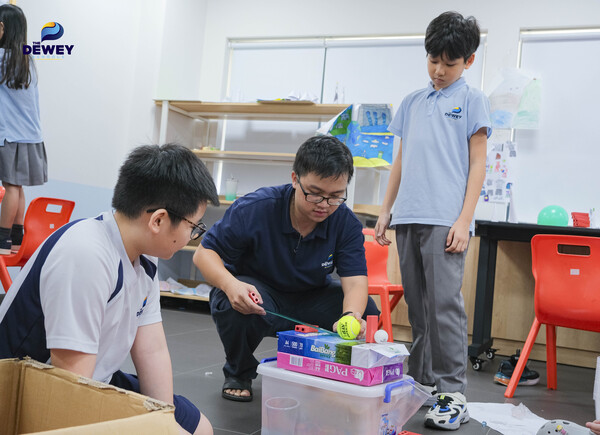
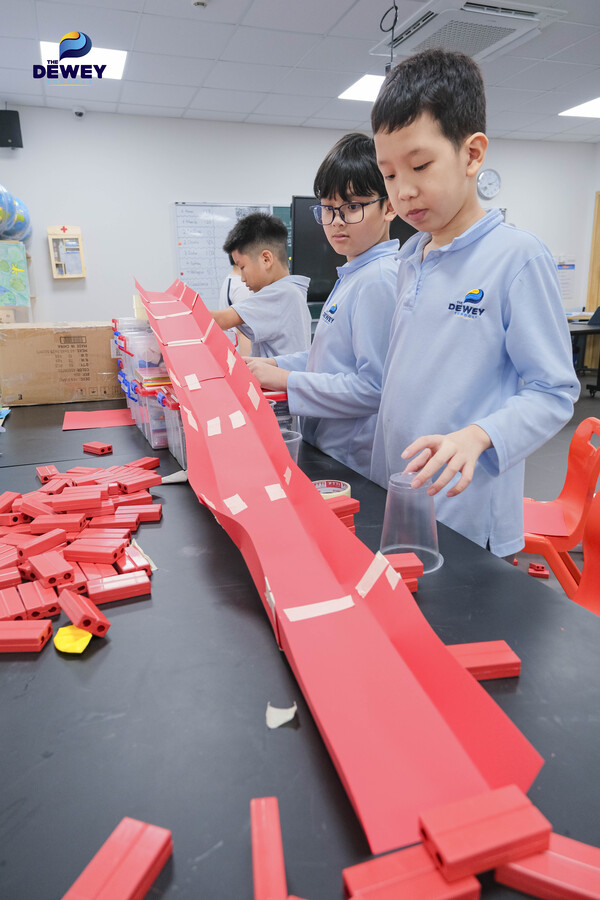
“Why does the same ball sometimes roll very fast, yet at other times slow down and eventually stop?” – This was the question posed by Mr. Lê Quang Tùng at the start of a Grade 5 Science lesson, introduced through a simulation video of a Rube Goldberg Chain Reaction Machine.
No formulas or definitions were given upfront. Instead, students observed the process, formed hypotheses, and engaged in lively discussions. “Is it because the slope is steeper?”, “Or because the pushing force is stronger?” Every idea was carefully noted by the teacher, because those initial hypotheses mark the very beginning of retracing the journey of a scientist.
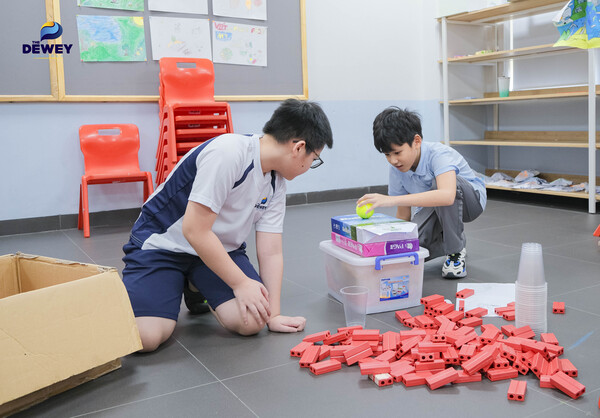
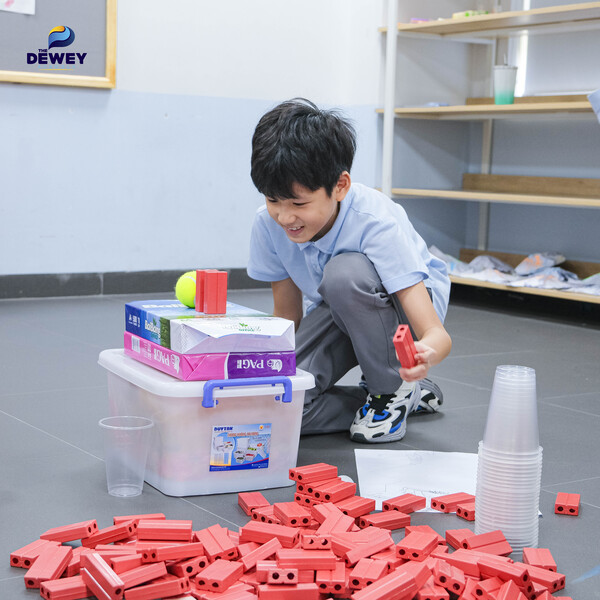
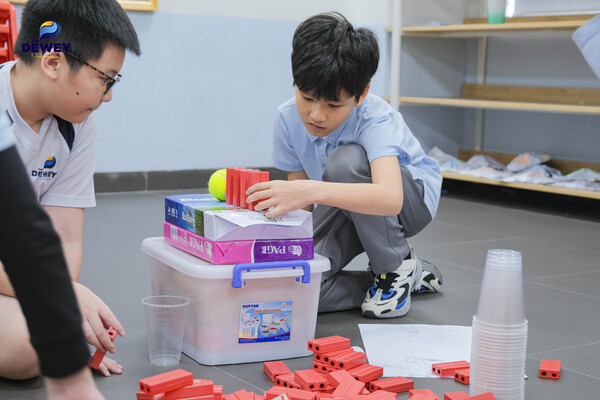
Through comparing hypotheses and conducting repeated experiments, students naturally arrived at concepts such as force, friction, potential and kinetic energy, and chain reactions – rather than memorizing ready-made definitions from a textbook.
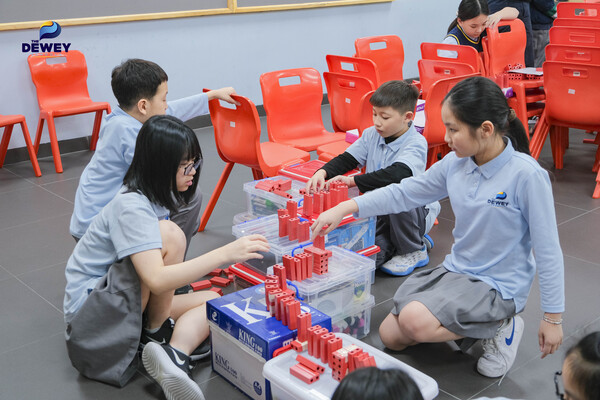
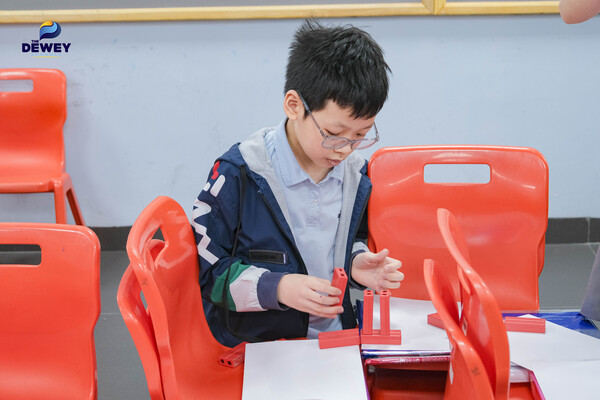
The Grade 5 Rube Goldberg machine project unfolded over the course of an entire month, involving multiple rounds of testing and adjustment. Each time the model failed to perform as expected, students learned to practice patience in the face of failure. The teacher did not step in to solve the problem; instead, he asked guiding questions, helping students review the entire process and identify the causes of failure. From there, students proactively broke the problem into smaller parts, tested again, and gradually developed the ability to anticipate the consequences of each change they made.
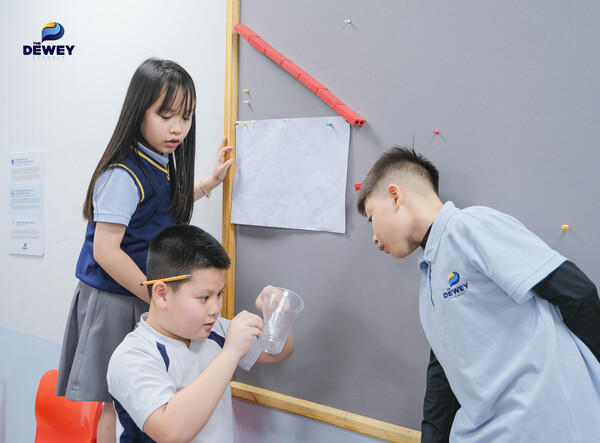
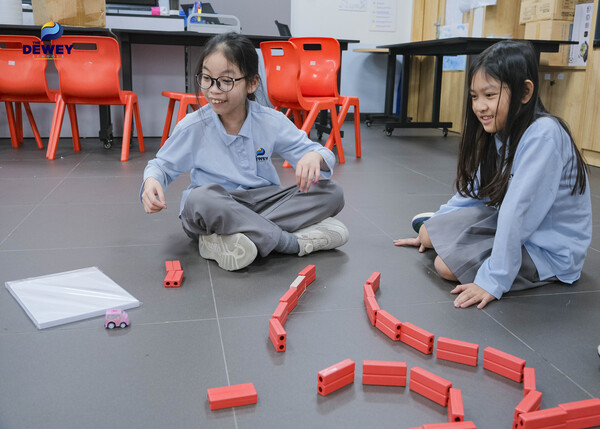
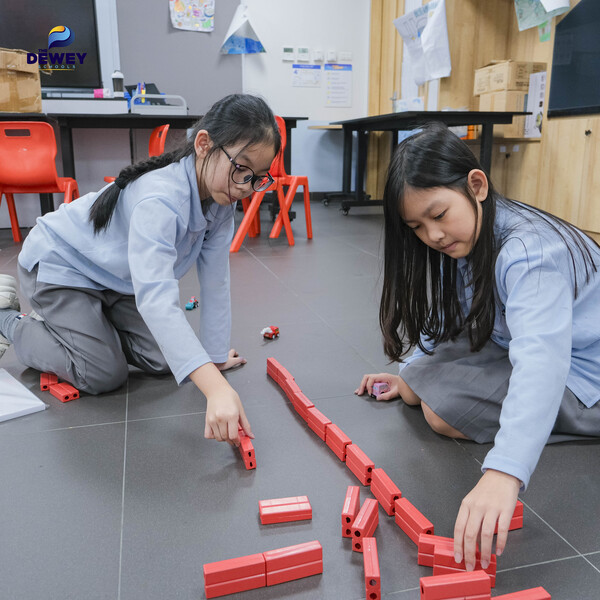
This approach is not limited to the Rube Goldberg project—it is a consistent spirit throughout the Science curriculum at The Dewey Schools. Mr. Lê Quang Tùng, Science & MDE Primary Teacher at Dewey Ocean Park, shares: “I believe experience does not replace knowledge, but it creates a genuine need for knowledge. At Dewey, students encounter the problem first. They are allowed to feel uncertain, to fully experience the ‘stuck’ moment of not yet understanding, and from there take initiative to find their own answers. At that point, scientific knowledge no longer appears as a ready-made answer, but becomes a tool for solving real-life problems.”
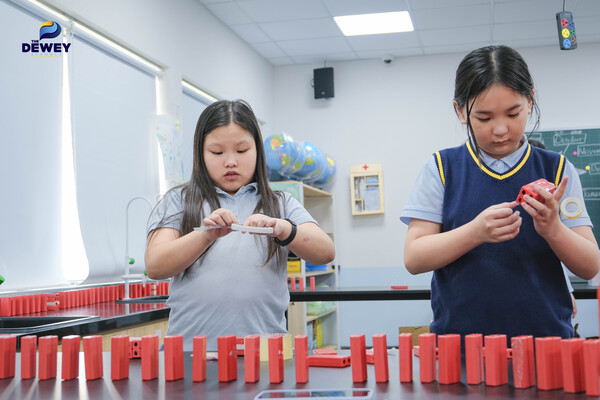
“Give the students something to do, not something to learn; and the doing is of such a nature as to demand thinking; learning naturally results.” This quote by John Dewey reflects the essence of experiential education at The Dewey Schools. From unsuccessful attempts to the moment of discovering solutions on their own, Dewey students are not only learning Science – they are learning to think like scientists. When failure is viewed as data, questions are valued more than answers, and experience becomes the starting point of knowledge, learning extends far beyond the classroom. It becomes the foundation that prepares students to step into a world without ready-made formulas, but one that always needs people who can think critically, experiment boldly, and continuously improve.
———
The “EXPERIENTIAL CYCLE” campaign by The Dewey Schools affirms an educational approach in which experience is not merely a means but the core of learning itself.
Here, every student is placed at the center of their developmental journey—guided to build self-directed learning capacity, independent thinking, and the confidence to take ownership of their own future.
Step into the dynamic world of experiential education here: https://tuyensinh.thedeweyschools.edu.vn/the-experiential…