
Which environment helps your child balance academics and extracurriculars? https://tinyurl.com/ycxnzf2s
According to the National Association for College Admission Counseling (NACAC), current global university admissions trends show that institutions no longer focus solely on GPA. Instead, they place strong emphasis on curriculum rigor, extracurricular activities, and personal essays. Many top universities in the U.S., such as Harvard and Stanford, have adopted a holistic review process—evaluating the entirety of a student’s journey, from experiences and projects to how they express their personal perspectives.
This reflects a clear reality: grades are no longer a competitive advantage—they are simply a prerequisite. In an environment filled with high-achieving students, what makes your child stand out?
WHAT KIND OF LEARNING ENVIRONMENT HELPS BUILD A DISTINCTIVE PROFILE?
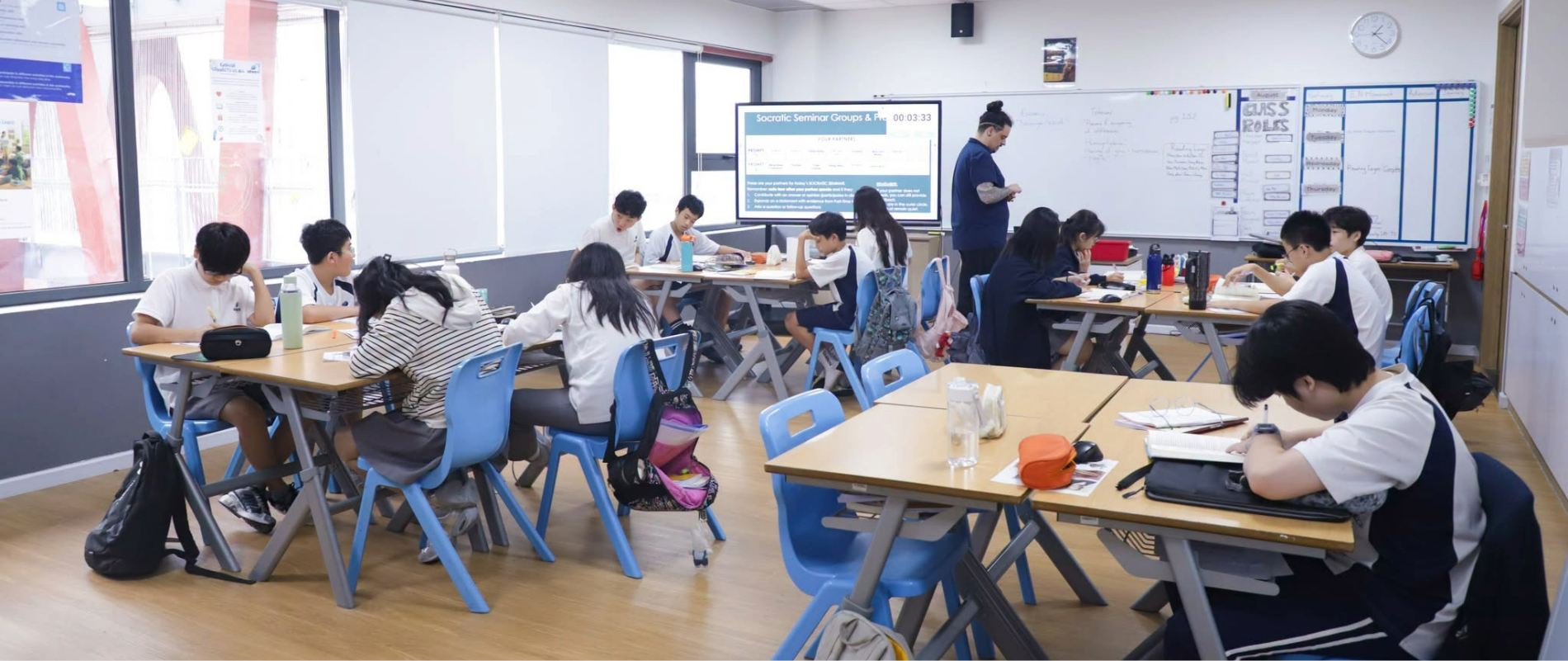
It is one where students actively construct knowledge, deeply understand core concepts, and apply them flexibly through purposefully designed experiential learning activities. Through this, they develop both intellectual capacity and essential skills as global citizens, ready to adapt to an ever-changing future.
- A program transferred from Mount Vernon School (USA), implemented alongside the Vietnamese Ministry of Education framework, ensures students build a strong academic foundation while developing analytical thinking, reasoning skills, and adaptability to higher academic standards.
- A structured Career and College Counseling program starting from Grade 6 helps students understand themselves and career pathways early, set clear academic goals, and optimize their profiles for admission to top Vietnamese universities such as Foreign Trade University, Banking Academy, Diplomatic Academy of Vietnam, National University of Civil Engineering, as well as prestigious global institutions like Monash University, Korea University, and the University of Sydney.
- Interdisciplinary projects across Mathematics, Literature, History, ICT, and Science enable students to apply knowledge in real-world contexts—from scientific research and product design to building business models—thereby developing systems thinking and the ability to connect knowledge flexibly.
- An English program aligned with Common Core standards equips students to achieve diverse academic goals. Students use English as a tool for research, presentations, debates, and participation in international competitions and academic contests. As a result, English goes beyond test scores to become a powerful instrument for learning and global competitiveness.
- In addition to academic competitions, students participate in business simulations, financial projects, and real-world problem-solving through competitions such as the JA/FedEx International Trade Challenge and the Vietnam SEIA Entrepreneurship Competition. These experiences allow them to turn ideas into real value—from planning and calculation to execution—fostering an application-driven mindset rather than purely theoretical learning.
👉 Explore a learning environment that helps your child build a distinctive profile:
https://tinyurl.com/ycxnzf2s
#TheDeweySchools #10yearstogo